

Categories
Charlotte News, New DevelopmentsPublished November 6, 2026
Uptown's Office Conversions: What Could They Mean for Charlotte Homebuyers?

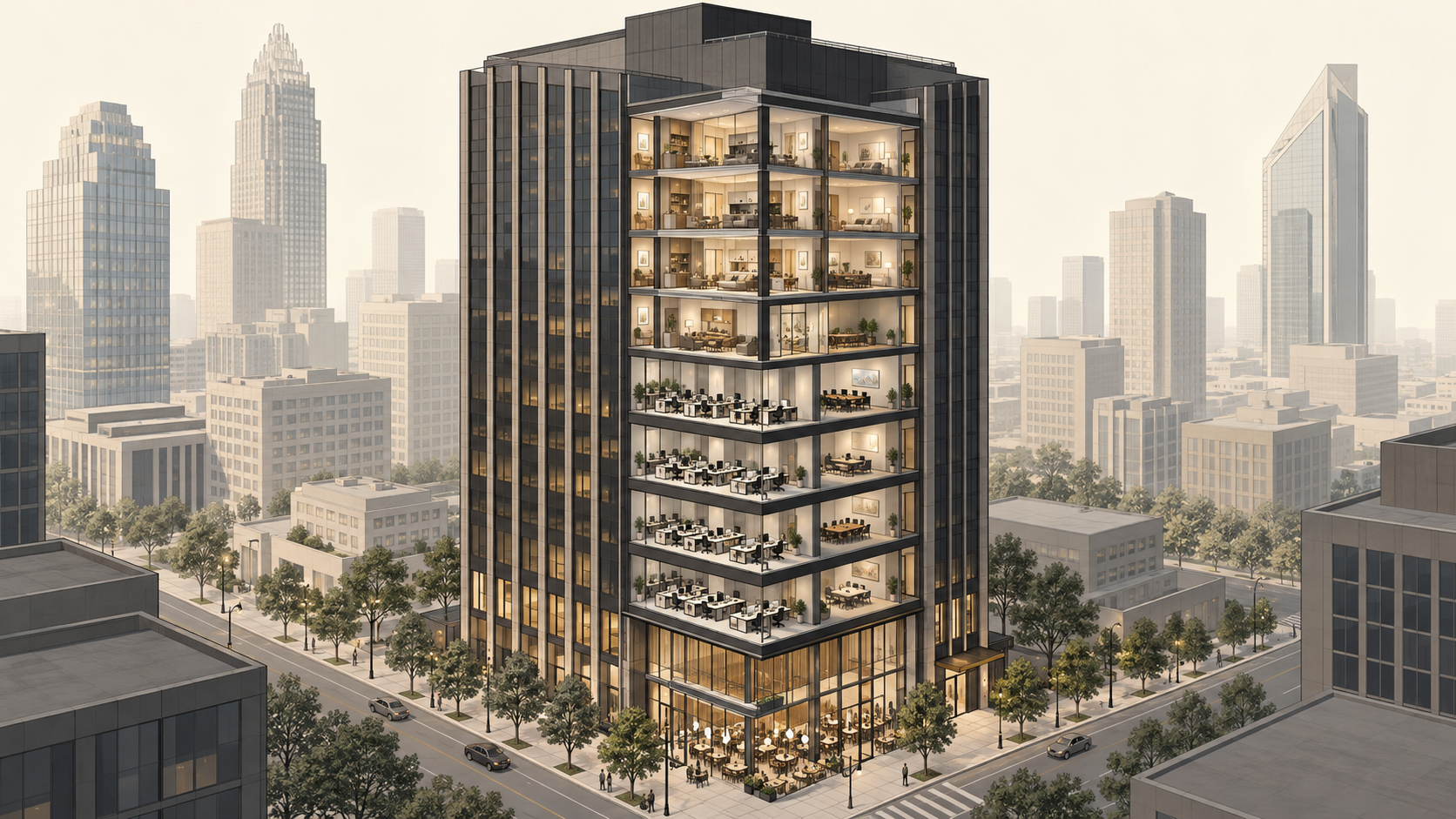
Conceptual illustration of an office-to-residential conversion, not a rendering of 301 South Tryon or another announced project.
Updated November 7, 2026: The full RealizeCharlotte episode is now live. Jay White looks at why older office towers are being considered for housing and hotels, what that could change about Uptown, and how homebuyers should weigh the opportunity against construction and ownership risks. Watch the full episode below, with the original Reel preview preserved at the end.
Watch the full RealizeCharlotte office-conversion episode on YouTube.
What happened at the former Two Wells Fargo Center?
Riverside Investment & Development and Singerman Real Estate acquired the complex at 301 South Tryon Street for $36.5 million in April 2026. Reporting published on Riverside's website describes a roughly 3.4-acre property with adjoining office buildings, retail space, an atrium, a plaza and parking. The developers plan to introduce a mix of residential, hospitality, office and retail uses.
The Reel contrasts that sale price with a value of about $204 million. The important distinction: the larger number is the property's reported county tax-assessed value, not a verified earlier purchase price or a measure of every Charlotte home's value. An office-complex sale cannot be used to conclude that nearby residential properties lost the same percentage. Read the acquisition report published by Riverside.
Are the apartments and hotel already open?
No. These are redevelopment plans, not completed homes or hotel rooms. An October Charlotte Observer report describes a planned renovation adding apartments and a hotel to the taller building, with office space, retail and shared public areas elsewhere in the complex. That report also covers the site's local historic landmark designation. Early project descriptions and later reporting differ on costs and unit counts, so buyers should use current approved plans rather than treat an early number as fixed. Read the October project update.
Why does mixing offices, homes and hotels matter?
Different uses bring people to a block for different reasons and at different times. A resident, a hotel guest and an office worker do not follow the same schedule. The developers' stated goal includes reworking the plaza and public spaces to bring more activity to the site. Whether that becomes a better everyday experience depends on execution, street-level uses, access and how the project connects to the surrounding blocks.
A conversion announcement alone does not guarantee a particular restaurant, a quieter street, lower rents or rising condo values. It is a reason to examine the exact location and proposed uses, not to assume that all of Uptown will change in the same way.
Why are older office towers being reconsidered?
The episode separates demand for office space from demand for a particular older building. A tower that loses a major tenant can face a different future from a newer office nearby. The October Charlotte Observer report cites JLL's Uptown office vacancy figure of 20.2%, but broker reports use different boundaries and dates. One market-wide percentage cannot tell you whether a particular building can attract tenants or support a conversion.
A low acquisition price is only the beginning. The buyer still has to fund the redesign, construction and ongoing operations. The local historic designation at 301 South Tryon is part of that story: the October reporting describes preservation and potential tax credits as important to the redevelopment. It is not proof that construction is complete or that every old office building can use the same financing approach.
Are other Uptown buildings following the same path?
Yes, but each project has its own plan and timeline. Across the area, 400 South Tryon, the former Wachovia Center, is planned for a W Hotel and 399 apartments. Axios reported the developer's September announcement, including a late-2029 opening target. That is a target, not a guaranteed move-in date.
The full episode also looks at Brooklyn & Church, 200 North College and the Johnston Building, alongside examples from other cities. Those examples make a useful point: announcing a conversion, securing approvals, starting work and opening the doors are different milestones. Do not add every proposed home to the supply available to rent or buy today.
Why can't every office building become apartments?
The episode's comparisons with Calgary, New York, Washington, D.C., and Chicago focus on the work behind a conversion. Floor depth, access to windows, plumbing, building systems, financing and approvals all matter. A building that works well as offices may need substantial changes to work as homes. A reused structure can be an opportunity without being a cheap or quick project.
For a buyer nearby, the useful question is less "Will conversions save Uptown?" and more "What is actually funded, approved and being built within a few blocks of this home?" Follow the individual project rather than importing another city's outcome into your price expectations.
Could you buy a home in the converted tower?
An announcement of apartments is not an announcement of condominium units for sale. The sources reviewed here do not establish a for-sale offering at this project. Buyers interested in ownership should separate the proposed rental and hospitality uses from existing condos nearby, and verify a specific property's availability and terms before making plans.
What should Uptown homebuyers check now?
Look at the blocks around the home you are considering. Check nearby construction, proposed entrances and loading areas, parking arrangements, walking routes, transit access and the businesses you expect to use. For an existing condo, review the HOA documents, dues, reserves and building condition. Compare recent sales in that building rather than using a commercial tower's acquisition price as a residential comparable.
Have your lender check the condo building's eligibility early, not only your personal preapproval. Ask about special assessments, reserve funding, insurance and rental restrictions. For negotiation, use current comparable sales, days on market and the seller's situation in that specific building. The episode's neighborhood price comparisons are snapshots, not a valuation of your unit or a promise of a discount.
If you may move again soon, compare buying with renting, including closing costs, dues, taxes, insurance, maintenance and the cost to sell. Investors should test actual rent, vacancy and management costs. More neighbors could support local businesses over time, while nearby construction and new rental supply may complicate the short-term picture. Neither result is automatic.
The takeaway is not that every empty tower is a bargain or every nearby condo will rise in value. A changing skyline is worth following, but your decision should work for the home, block, loan and budget you are choosing today.
Watch the RealizeCharlotte Reel preview here.
Connect With RealizeCharlotte
📱 Instagram | TikTok | YouTube
https://instagram.com/realizecharlotte
https://tiktok.com/@realizecharlotte
https://youtube.com/@realizecharlotte
Work With the Jay White Team
Buy • Sell • Invest • Build Your Career
🤝 Careers: https://thejaywhiteteam.com/careers
or another way