Categories
Charlotte News, New DevelopmentsPublished November 6, 2026
Fort Mill's Walmart Land Rezoning: What Should Homebuyers Check?

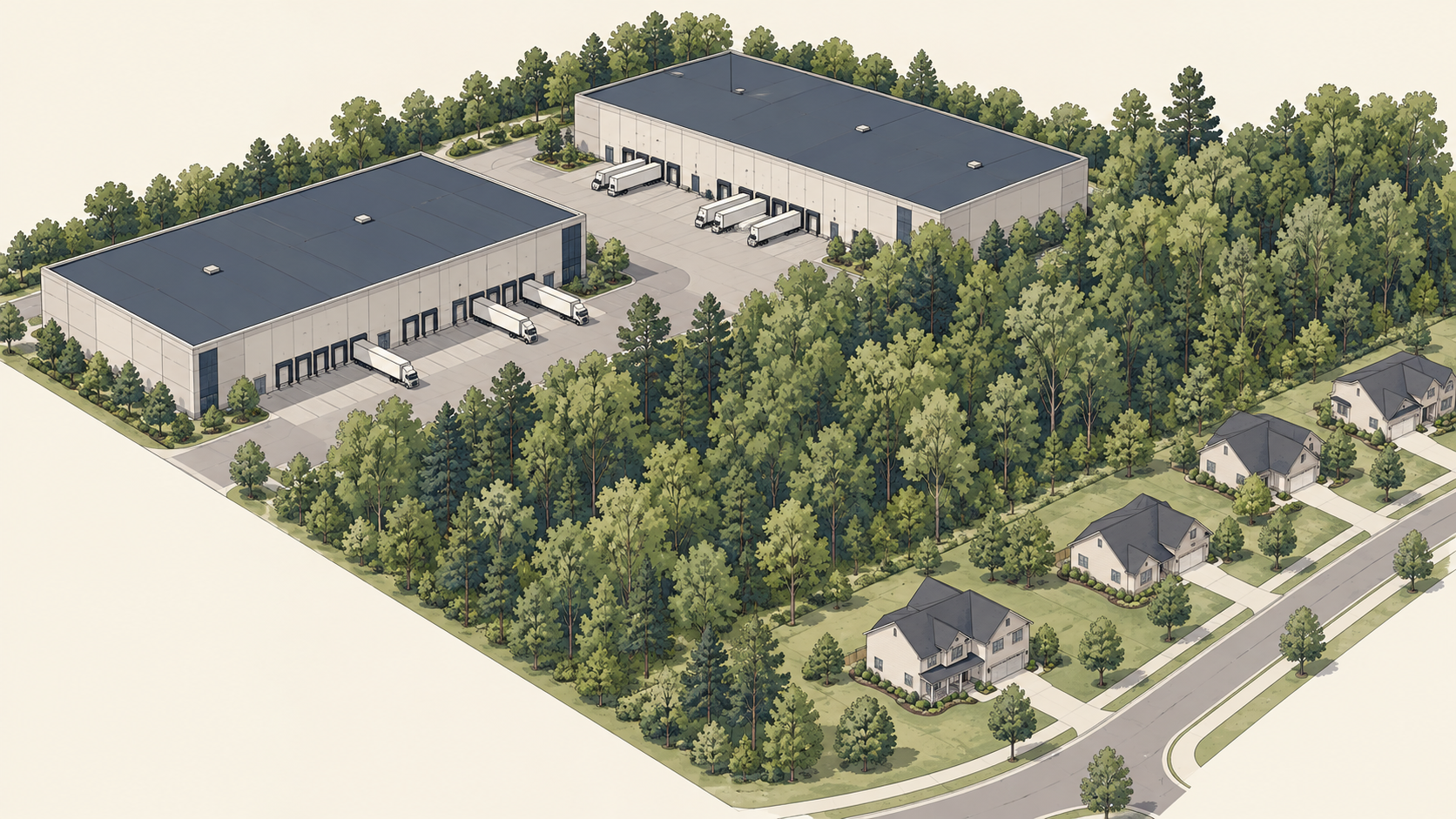
Conceptual illustration of warehouses, a wooded buffer and nearby homes, not a rendering or site plan of this project.
A vacant property can change the way a neighborhood feels long after someone buys a home nearby. In the latest RealizeCharlotte Reel, Jay looks at Walmart-owned land at U.S. 21 and Flint Hill Road in the Fort Mill area, where a planned grocery store never opened and York County has now approved a change to light-industrial zoning. The lesson for buyers is to investigate the land around a home, not just the listing itself.
What changed at the Walmart-owned property?
York County's planning file describes a request to rezone 24.06 acres of a larger 27.03-acre property from General Commercial to Light Industrial. The proposal is for warehousing, wholesale and distribution space with a combined building footprint of approximately 270,500 square feet. The remaining general-commercial land was identified for commercial outparcels. Local reporting says County Council gave its final rezoning approval on October 5, 2026.
That distinction matters: the roughly 24-acre rezoning area is not the entire property, and rezoning is not the same as completed construction or an operating warehouse. Read the county planning staff report for Case 26-27.
Why did the proposal draw opposition?
County planning staff recommended denial. Their report said the request was inconsistent with the York Forward 2035 future land-use plan, which designates the area for neighborhood residential uses and compatible development. It also raised concerns about the scale and compatibility of industrial uses beside existing homes and a religious facility. The Planning Commission also recommended denial, according to local reporting, before County Council approved the rezoning.
The Reel highlights two proposed buildings and more than 100 loading docks. Reports describe approximately 105 docks across the buildings. Those figures describe the proposal, not a statement that those docks are already built or in use. Nearby residents' concerns included truck traffic, noise and the relationship to homes and Flint Hill Baptist Church's cemetery.
What restrictions and buffers should buyers understand?
The planning report identifies a 250-foot separation requirement from the nearest dwelling unit and religious facility for the intended warehouse and distribution use. That should not be read as a promise of a continuous 250-foot planted tree buffer around every boundary. Local reporting also describes inward-facing docks and restrictions on several industrial uses, including data centers. The exact recorded restrictions and approved plans matter more than a general zoning label.
Traffic requirements can change during review. The Post and Courier reported that council accepted an existing traffic study rather than requiring a new survey before its final vote, with turn-lane improvements recommended. A buyer should review the latest approved road and site plans rather than assume an earlier traffic condition is still unchanged. Read the October 9 report on the final vote.
How can you check the land around a home?
Start with the parcel, not a sales pitch about what might go there. Ask the relevant planning department for current zoning, pending rezoning cases, approved site plans and any recorded conditions. Look at how the proposed entrances, loading areas, lighting and buffers relate to the specific home. A future land-use map shows policy direction; it is not the same thing as current zoning or a guarantee that an individual proposal will be denied.
Visit at different times, consider the roads you will actually use, and ask what is approved versus merely proposed. If a nearby project would affect your decision, have the applicable documents reviewed before you commit, rather than relying on an old sign, a remembered grocery-store plan or an online map alone.
Does this mean buyers should avoid Fort Mill?
No single rezoning answers that question. The effect depends on the exact property, surrounding land uses and what matters to you. This case is a reminder to include nearby development in due diligence wherever you buy. A home can fit your needs while a particular road, neighboring parcel or proposed use does not. Evaluate those details together.
Check out the full video here.
Connect With RealizeCharlotte
📱 Instagram | TikTok | YouTube
https://instagram.com/realizecharlotte
https://tiktok.com/@realizecharlotte
https://youtube.com/@realizecharlotte
Work With the Jay White Team
Buy • Sell • Invest • Build Your Career
🤝 Careers: https://thejaywhiteteam.com/careers
or another way