

Categories
Charlotte News, Living In Charlotte, Market UpdatesPublished November 27, 2026
Charlotte Housing Affordability: What Can Buyers Learn From the 75% Figure?

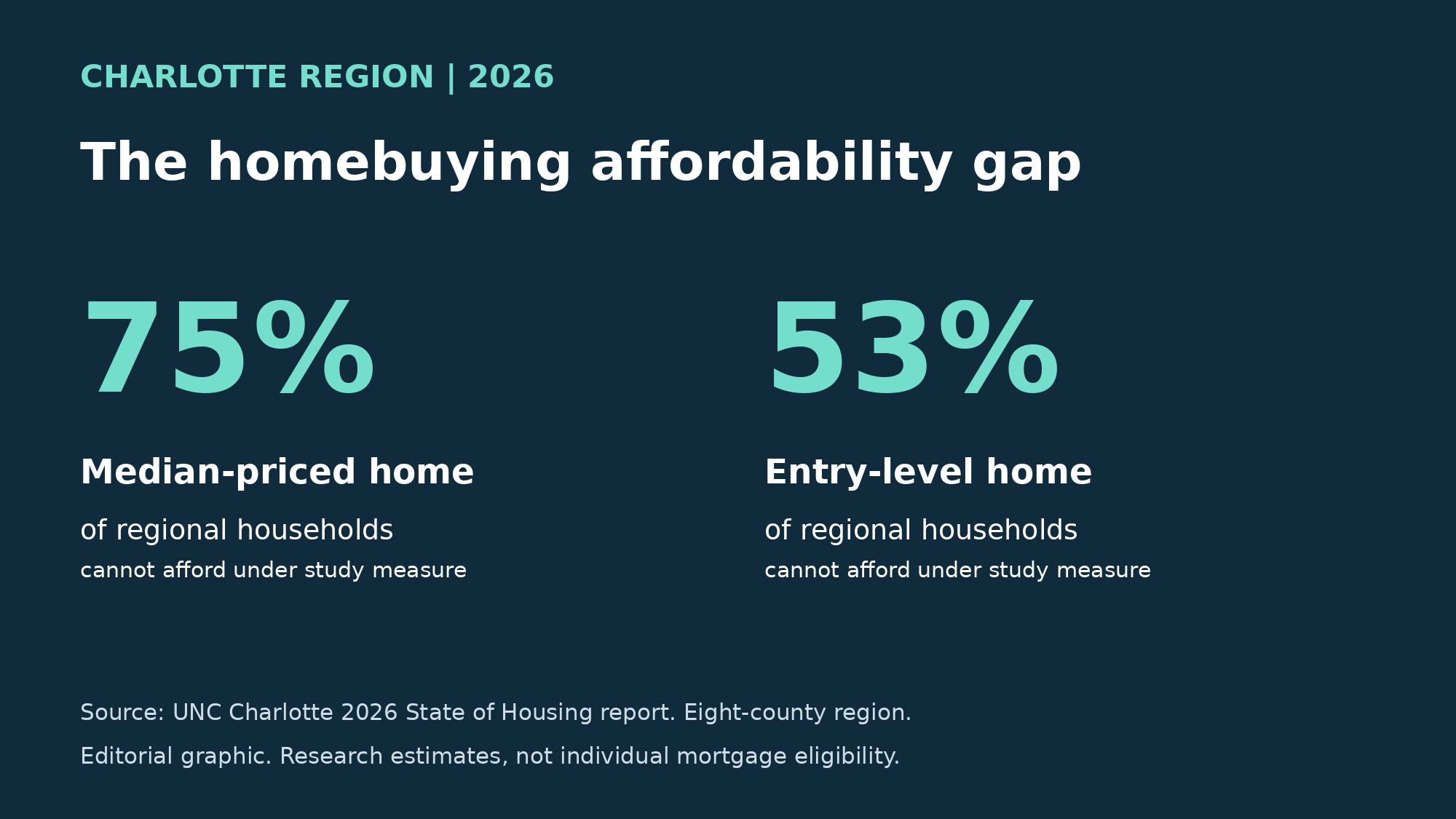
UNC Charlotte's 2026 State of Housing report puts numbers behind a challenge many buyers already feel: 75% of households in the Charlotte region cannot afford the median-priced home under the study's affordability measure. Our latest RealizeCharlotte episode looks at that gap, Charlotte's new housing bond and programs that may help eligible buyers.
What does the 75% figure actually measure?
The university's November 17 report covers an eight-county region, not only Charlotte city limits. It estimates that the annual household income needed to afford a median-priced home of $450,000 reached $160,410 in 2026, compared with $79,014 in 2020.
It also finds that 53% of regional households cannot afford an entry-level home, defined at the 10th price percentile. These are research estimates, not a lender's decision on your application or a statement that every home requires the same income. Your loan terms, debts, down payment, taxes and insurance change the numbers.
Why has more construction not solved the affordability gap?
The report says housing additions exceeded household growth for a third consecutive year, but higher prices and mortgage rates reversed recent affordability improvements. More supply helps the market over time; it does not erase financing costs or guarantee a lower price on a particular home.
The university also reports softer effective apartment rents following a wave of deliveries, alongside a slowing construction pipeline. That is a reason to compare current rental offers carefully, not assume every renter will receive the regional average or that rents must keep falling.
What did voters approve in the housing bond?
Charlotte voters approved a $125 million housing bond on November 3, 2026. WFAE identifies it as the city's largest housing bond to date, supporting the Housing Trust Fund's affordable-housing work.
Bond approval authorizes public financing. It is not an automatic $125 million cash distribution to homebuyers, and it does not mean all funded homes have already been built. Project approvals, implementation and individual program rules still matter.
How does House Charlotte assistance work?
The city's current homeownership page says eligible first-time buyers may receive up to $80,000 through deferred and forgivable loan options. That maximum combines a base amount with additional matching assistance. It is not the amount every applicant receives.
The current program overview lists a maximum total home price of $365,000 and limits assistance to eligible City of Charlotte locations. It requires homebuyer education and counseling, and assistance must be requested through a House Charlotte-approved lender.
Income limits depend on household circumstances. The published income examples are based on a family of four, so do not use a single headline figure to decide your own eligibility. Ask the program team or an approved lender to confirm your household size, property address, available funding, match requirements and loan terms before relying on assistance.
Are state programs another option?
North Carolina's NC 1st Home Advantage Down Payment program lists $15,000 for qualifying buyers. The agency describes a 0% deferred second mortgage with forgiveness in years 11 through 15. Income, purchase-price, occupancy and other requirements apply; a sale or refinance before full forgiveness can create repayment obligations.
For a South Carolina purchase, SC Housing's Homebuyer program lists $10,000 in down-payment and closing-cost assistance, with forgiveness tied to remaining in the property for 15 years. Its mortgage and assistance rules differ from North Carolina's. Use an approved lending partner to check the current program, property and repayment conditions.
These programs are separate options, not a promise that every benefit can be stacked together. Ask for a written comparison of the mortgage rate, full monthly payment, fees, second liens and what happens if you move or refinance.
What should a buyer do before shopping?
- Set a full monthly budget including taxes, insurance, HOA dues and maintenance.
- Have an approved lender check assistance eligibility before assuming a home qualifies.
- Compare financing with and without assistance, including repayment or forgiveness conditions.
- Keep renting in the comparison if buying would leave too little room for emergencies.
Our take: the regional affordability gap is real, but your next step should be based on your own budget and verified options. Assistance can close part of a gap for eligible households. It should not be used to justify a payment you cannot comfortably carry.
Where can you watch the full episode?
Watch the full RealizeCharlotte housing affordability episode on YouTube.
Where can you verify the figures and program rules?
See UNC Charlotte's report summary, WFAE's bond results report, the city's homeownership page, NC Housing Finance Agency program details and SC Housing's homebuyer programs. Figures and rules checked November 26, 2026; funding and eligibility remain subject to change.
Connect With RealizeCharlotte
📱 Instagram | TikTok | YouTube
https://instagram.com/realizecharlotte
https://tiktok.com/@realizecharlotte
https://youtube.com/@realizecharlotte
Work With the Jay White Team
Buy • Sell • Invest • Build Your Career
🤝 Careers: https://thejaywhiteteam.com/careers
or another way